2026 Year-End Tax Planning: What Fabrication Shops Need to Know
With 100% bonus depreciation and a higher Section 179 deduction limit, 2026 may be an opportunity for fabrication shops to invest in qualifying equipment while reducing taxable income. Here's what to know before year-end.
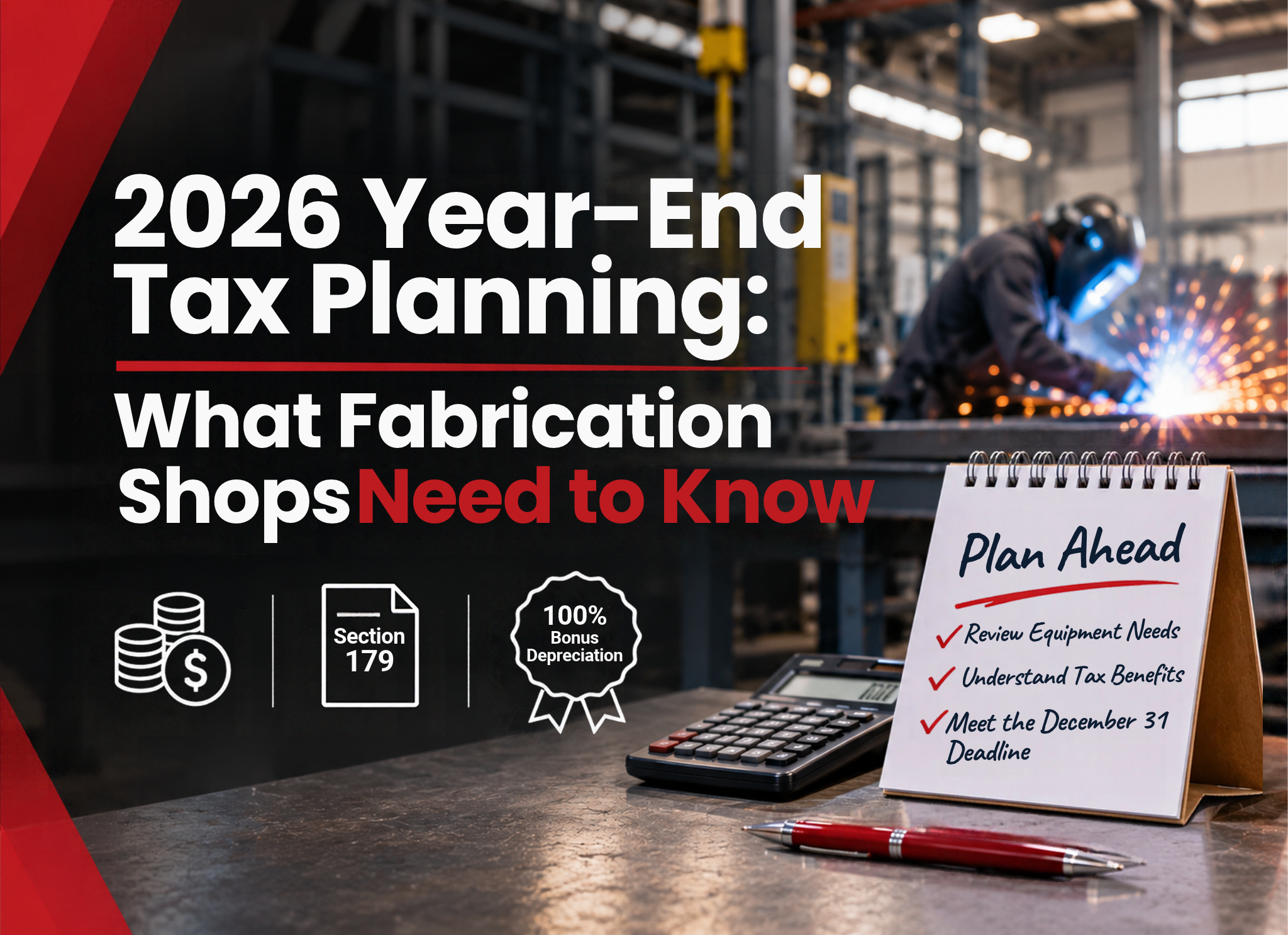
As the year winds down, structural steel fabricators should review their equipment needs and consider two federal tax provisions: Section 179 expensing and 100% bonus depreciation.
What's New for 2026?
1. Section 179: Deduct Up to $2.56 Million
For 2026, the maximum Section 179 deduction is $2,560,000. The deduction begins to phase out when qualifying equipment purchases exceed $4,090,000.
Qualifying equipment may include:
Beam processing and drilling lines
Plate processing and plasma cutting systems
Fiber laser cutting machines
Saws and material handling equipment
Robotic welding and automation systems
New and certain used equipment may qualify, subject to IRS requirements and business income limitations.
2. 100% Bonus Depreciation
The One Big Beautiful Bill Act restored 100% bonus depreciation for qualifying property acquired and placed in service after January 19, 2025.
Eligible businesses may deduct the full depreciable basis of qualifying equipment in the first year. Unlike Section 179, bonus depreciation generally has no annual dollar cap or business taxable income limitation.
Certain used equipment may also qualify if it meets IRS acquisition and prior-use requirements. Section 179 and bonus depreciation may be used together, depending on the equipment and the business's tax situation.
Want to estimate your potential equipment tax savings?
Use the 2026 Equipment Tax Estimator to explore potential Section 179 deductions and bonus depreciation scenarios.
The IRS does not currently offer a dedicated calculator for these equipment tax deductions. This third-party estimator can help you explore potential savings. Results are estimates and should be reviewed with your tax professional.
Why Timing Matters Before December 31
Ordering equipment or making a deposit does not automatically qualify it for a 2026 deduction.
For calendar-year businesses, qualifying equipment generally must be placed in service by December 31, 2026 to claim the applicable deduction on a 2026 tax return. This means the equipment must be ready and available for its intended business use. Acquisition-date and other eligibility requirements also apply.
Don't Overlook Used Equipment
Qualifying used machinery may also be eligible for Section 179 or bonus depreciation, depending on its acquisition history and IRS requirements.
For shops looking to address bottlenecks or add capacity, used equipment may offer an option without the lead time of a new build.
Consider how an investment could help your operation:
Increase production capacity.
Reduce manual handling and repetitive work.
Improve cutting, drilling, and welding workflows.
Make better use of labor and floor space.
Take on additional work.
Plan Your Next Equipment Investment with JPS
JPS International helps structural steel fabricators explore equipment solutions that fit their production requirements, facility, and business goals.
Whether you're considering new automation or looking for used machinery, we're here to help you evaluate your options.
Let's make your next equipment investment count.
Schedule a free consultation at jpsint.com or explore available machinery at machinery.jpsint.com.
Tax Disclaimer: This article is for general informational purposes only and does not constitute tax, legal, or accounting advice. Equipment eligibility and deductions depend on individual circumstances and applicable IRS requirements. Consult a qualified tax professional before making purchasing or tax-planning decisions.
Sources
The following IRS resources were referenced in preparing this article:
IRS Publication 946: How To Depreciate Property – Section 179, bonus depreciation, qualifying property, and placed-in-service rules.
IRS: Guidance on the Additional First Year Depreciation Deduction – Guidance on 100% bonus depreciation under the One Big Beautiful Bill Act.
IRS Instructions for Form 4562 – Depreciation deductions, Section 179, and the special depreciation allowance.
The LeasePoint 2026 Equipment Tax Estimator is a third-party educational tool, not an official IRS calculator. Results are estimates and should be reviewed with a qualified tax professional.